

Phone
01204 89 6440General Enquiries
hello@statuo.co.ukClient Enquiries
accounts@statuo.co.ukHello I’m Adam // General Manager
Drive quality traffic to your site
Talk to me todayHello I’m Faye // Marketing Director
Drive quality traffic to your site
Talk to me todayLearn how backlinks support your search visibility, what makes a link worth having and eight practical ways to earn high-quality links from relevant websites.
Katie White
Aug 24, 2026
Backlinks are links from other websites to yours. If a journalist references your research, a supplier lists you as a partner or another business recommends one of your guides, you’ve gained a backlink.
But why do they matter?
Well, backlinks help search engines discover content and understand which pages other websites consider worth referencing. They can support your organic rankings, but they can also send new visitors to your website and introduce your business to a much wider audience.
But building backlinks for SEO isn’t about collecting as many links as possible. One relevant link from a trusted publication can be worth far more than hundreds from random websites nobody visits.
So, how do you get backlinks that are actually worth having?
Already familiar with how backlinks work? Skip straight to our eight ways to build high-quality backlinks.
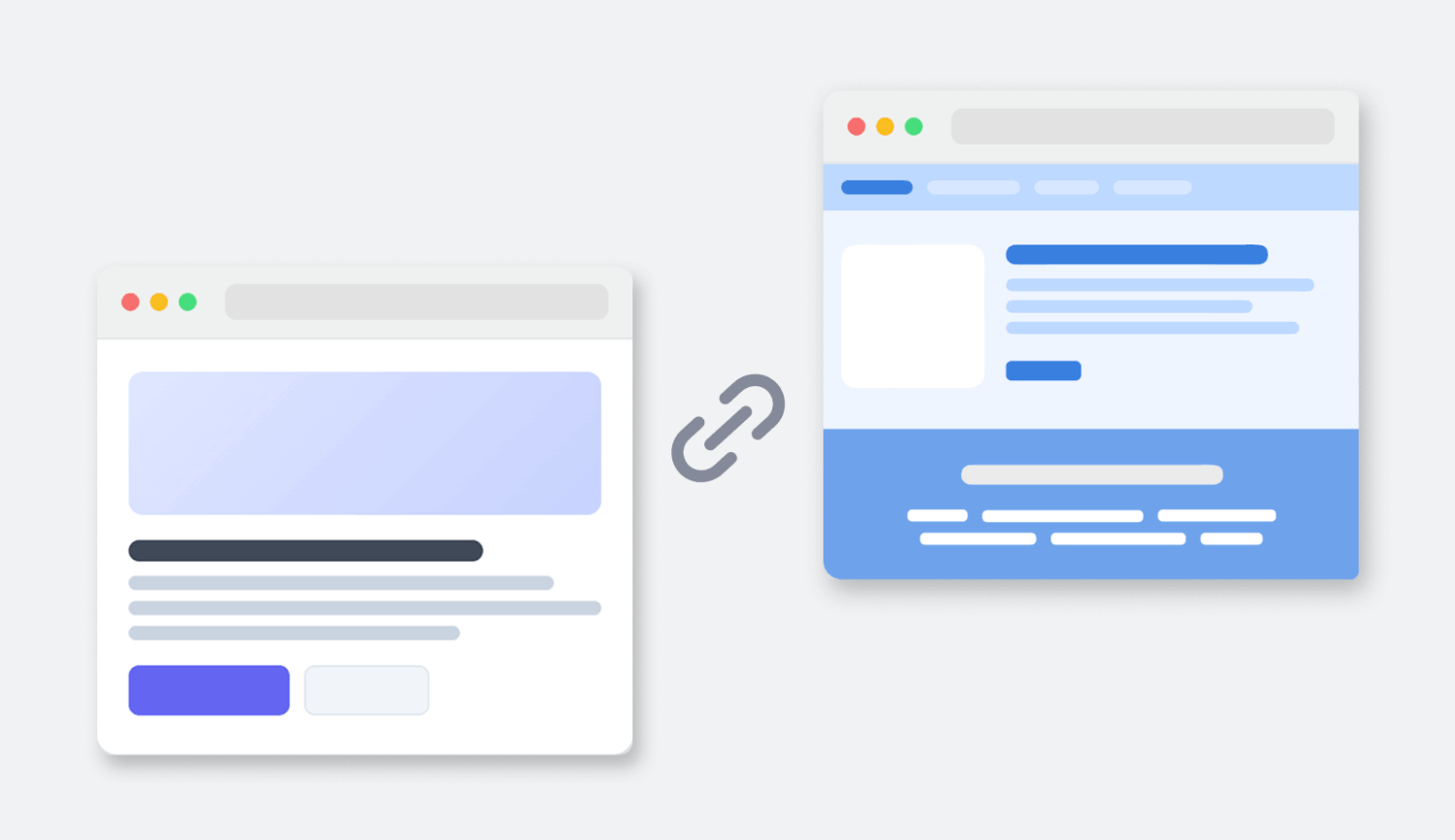
Imagine an interior designer writes an article about choosing paint colours and links to a colour guide created by a paint supplier. For the interior designer, that’s an external link because it sends readers to another website. For the paint supplier, it’s a backlink because someone else is linking to their content.
If the interior designer linked to another page on their own website, that would be an internal link instead.
So, what happens once that backlink is there?
When Google crawls the interior designer’s article, it can follow the link to discover the supplier’s colour guide. The words used within the link, known as the anchor text, and the paragraph surrounding it also help Google understand what it can expect to find on the page.
Google explains that links help its crawlers discover pages, while descriptive anchor text gives users and search engines more context about where a link leads.
However, Google doesn’t treat every backlink equally.
A natural link from a respected interiors publication within an article about paint colours makes sense.
A link from an unrelated website with no genuine audience won’t carry the same value.
It also isn’t simply a case of collecting the most backlinks. Links are one of many signals Google can use when deciding which pages to show, alongside the quality, relevance and usability of the content itself.
And rankings aren’t the only benefit.
Someone reading the interior designer’s article might follow the link, discover the paint supplier and eventually become a customer. The feature could introduce the supplier to a new audience, strengthen its credibility and begin a useful relationship with the designer or publication.
Here’s a useful way to judge a backlink: if it sends the right people to your website, strengthens your reputation or leads to an enquiry, it has created value, even if your rankings don’t immediately change.
You might hear SEOs talk about backlinks passing “link juice”. This is an informal way of describing the ranking value, sometimes called link equity, that a link may pass to another page.
That doesn’t mean the website linking to you loses any of its own authority. Think of the link more like a recommendation.
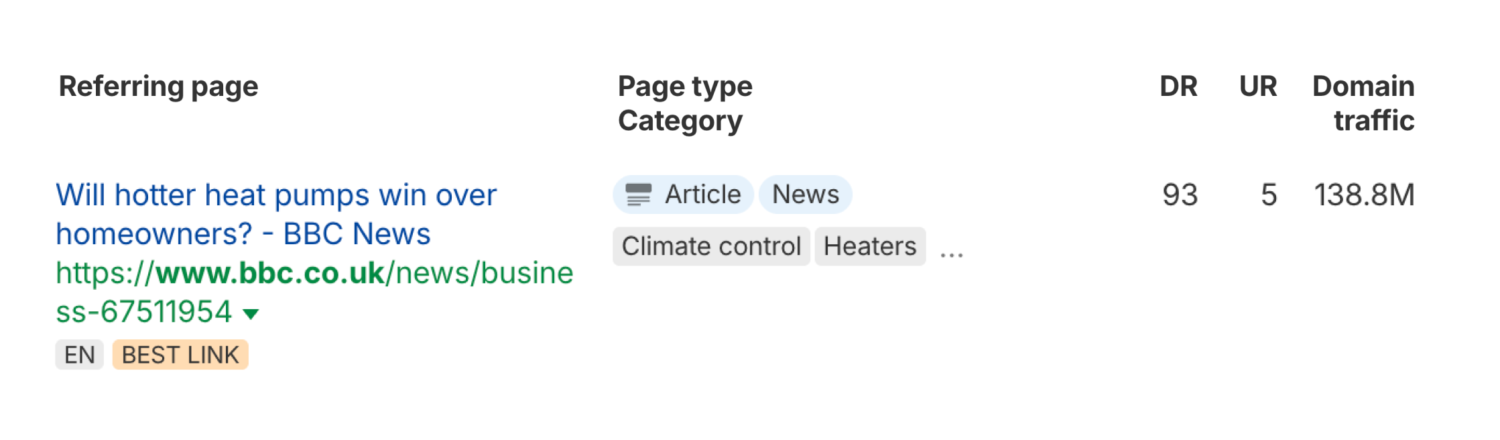
For example, BBC News included a link to our client iHeat in an article exploring whether higher-temperature heat pumps could win over homeowners.
Ahrefs gives the BBC website a Domain Rating of 93, but the score isn’t the only reason this backlink is valuable. The link comes from an established publication with a genuine audience and appears within editorial content directly related to iHeat’s industry.
It’s that combination of reputation, relevance and context that makes the link much more valuable than one from an unrelated website nobody reads.
Link building is the process of earning links from other websites. But the word “building” can make it sound like something you can easily manufacture.
You can’t, or at least, you shouldn’t.
Sometimes another website will discover your content and link to it without you doing anything. Other times, you might create a useful resource and actively show it to the people who would benefit from referencing it. Links can also come from existing business relationships, media coverage and relevant industry listings.
The common thread is value. There needs to be a genuine reason for the other website to send its readers to you.
You can’t force a reputable website to link to your content. You can only create something its audience would find useful and make a convincing case for why it belongs there.
Before chasing a backlink, put the SEO metrics to one side and look at the website as if you were a potential customer.
Would you trust it? Does the link make sense? Would you actually want someone to find your business there?
Start with its subject and audience.
If you’re an accountancy firm, a link from a respected small-business publication makes sense because its readers could realistically need your services. A link from an unrelated entertainment blog is much harder to justify, regardless of how large the website might be.
Don’t judge a website by its homepage or an SEO score alone. Look through what it publishes.
Are the articles useful and recently updated? Are there identifiable authors?
Does the website appear to have real readers? Most importantly, would you be happy for a potential customer to discover your business there?
If the answer is no, it probably isn’t a backlink worth pursuing.
A good backlink usually has a clear purpose. It might direct the reader to supporting evidence, a useful tool, the original source of a statistic or somewhere they can explore the subject in more detail.
If the only explanation for the link is that somebody paid for it, exchanged another link for it or added it purely to influence Google, that should raise questions.
A link placed naturally within a relevant article gives readers and search engines clear context. They can see what is being referenced and why.
That is very different from a link hidden in a footer, squeezed into an unrelated author biography or placed on a directory page alongside hundreds of other businesses.
Domain Authority and Domain Rating are scores created by third-party SEO tools. Google does not assign or directly use either metric.
They can be useful when comparing websites, but they shouldn’t make the decision for you. A smaller specialist publication with a genuine audience could be far more valuable than an unrelated website with an impressive-looking score.
Now for the part you came for: how do you actually get them?
Some of the methods below are quick wins you could try today. Others require research, original content and a much bigger investment of time.
What they all have in common is that you’re giving another website a genuine reason to mention you, as opposed to paying for spammy links that actually hurt your domain authority.
Someone has already written about your business. The difficult part is done: they know who you are and considered you worth mentioning. They simply haven’t included a link.
This is known as an unlinked brand mention.
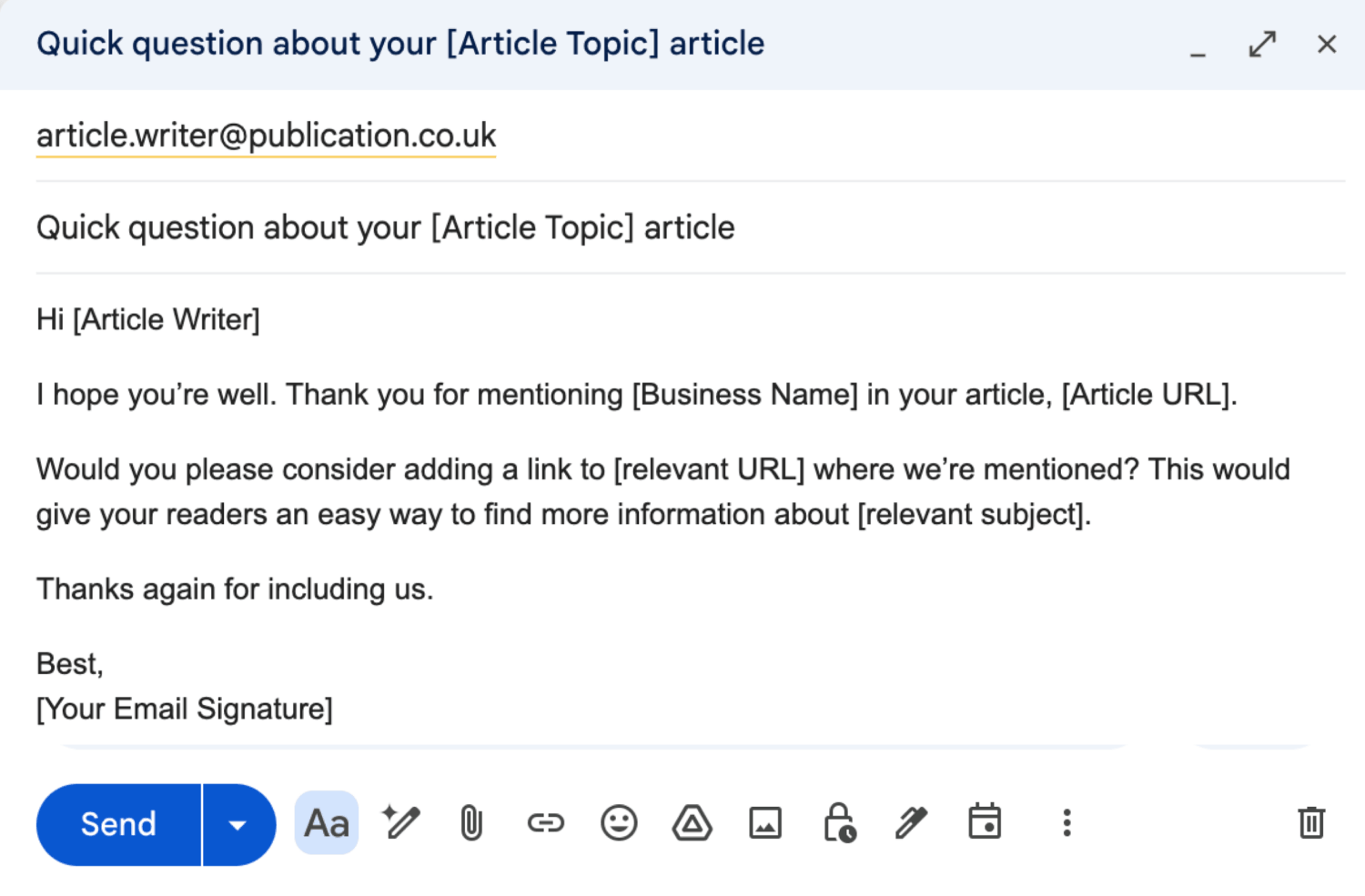
The mention could be your company name, one of your products, a member of your team or a piece of research you published. You can find them through brand-monitoring tools, Google Alerts or a simple Google search for your business name.
Once you find one, contact the writer or publication and politely ask whether they would consider adding one.
Explain why the link would help their reader and point them towards the most useful page, (not necessarily your homepage).
Keep the request friendly. The publication doesn’t owe you a backlink, and demanding one is unlikely to begin a particularly useful relationship.
Before emailing hundreds of people you’ve never spoken to, look at the businesses and organisations that already know you.
These could include:
There may already be a sensible reason for one of them to mention you. A supplier could feature your business in a customer story. A professional body might maintain a directory of accredited members.
An event website could list its speakers, sponsors or exhibitors. You could also offer a genuine testimonial to a relevant service your company uses. If the business publishes it as a case study or customer story, it may include a link back to your website.
The important word here is relevant. An SEO agency providing a testimonial for the SEO software it uses makes sense. Asking the company that supplies its office pens for a backlink probably doesn’t.
Journalists and content writers need evidence. They need statistics, examples, expert insights and reliable sources to support what they’re saying.
If you create the resource they need, your page could continue earning backlinks long after you publish it.
Useful linkable resources could include:
For example, an accountancy firm could analyse anonymised invoice data to publish an annual report on how long small businesses are waiting to be paid.
That gives journalists an original statistic, gives business publications a useful source and allows the accountancy firm to demonstrate its expertise.
Start by thinking about the information people regularly need within your industry. What questions require evidence? Which statistics keep appearing in articles? Is everyone linking to the same outdated source?
Then create something more useful. Make the methodology clear, link to your original sources and keep the page updated. If journalists find your page but can’t work out where the figures came from, they’ll be much less comfortable referencing it.
Journalists regularly need someone who genuinely understands the subject they’re covering. If you can give them a clear, useful answer before their deadline, you could earn coverage and a backlink.
Platforms such as ResponseSource, Qwoted, HARO and social hashtags such as #journorequest connect journalists with relevant experts.
The process is fairly simple. A journalist explains the story they’re working on, the type of expert they need and when they need a response. If the request matches your experience, you send them a useful contribution.
The key is to answer the question, not turn your response into an advert.
Lead with the information they asked for, explain your point clearly and give them something they can realistically quote. You can include a short biography and your credentials afterwards so they can verify who you are.
Speed matters too. Journalists often work to tight deadlines and may stop looking once they have enough useful responses. Set up alerts for the subjects you can speak about confidently and respond while the request is still active.
Coverage and backlinks are never guaranteed. However, even when one response isn’t used, consistently providing thoughtful input can help you build relationships with writers covering your industry.
You don’t always have to wait for a journalist to ask for help. Sometimes you can create the story yourself.
That is the basic idea behind digital PR: using your expertise, research or data to create something publications will want to cover.
A campaign could be based on:
Start with the headline.
What might a publication realistically write about your findings? More importantly, why would its readers care?
If you can’t answer those questions, collecting the data probably won’t rescue the idea. A campaign needs an interesting hook as well as a sound methodology.
For example, a recruitment company could analyse job adverts to reveal which skills are growing fastest across different UK industries. The underlying data connects directly to its expertise, while the findings give careers and business journalists something new to discuss.
Once the story is ready, identify the journalists and publications that regularly cover the subject. Your outreach should explain the main finding quickly, show why it matters to their readers and provide everything they need to verify it.
Websites change. Articles are deleted, businesses close and useful resources disappear, but the links pointing to those pages often remain.
That creates a broken-link opportunity.
Using a backlink tool such as Ahrefs or Semrush, you can look for pages on competitors’ websites that have earned links but now return an error. The Wayback Machine may show you what the original page contained and why other websites referenced it.
You can then create your own resource covering the same need. That doesn’t mean copying the old page. Your version should be current, original and genuinely useful in its own right.
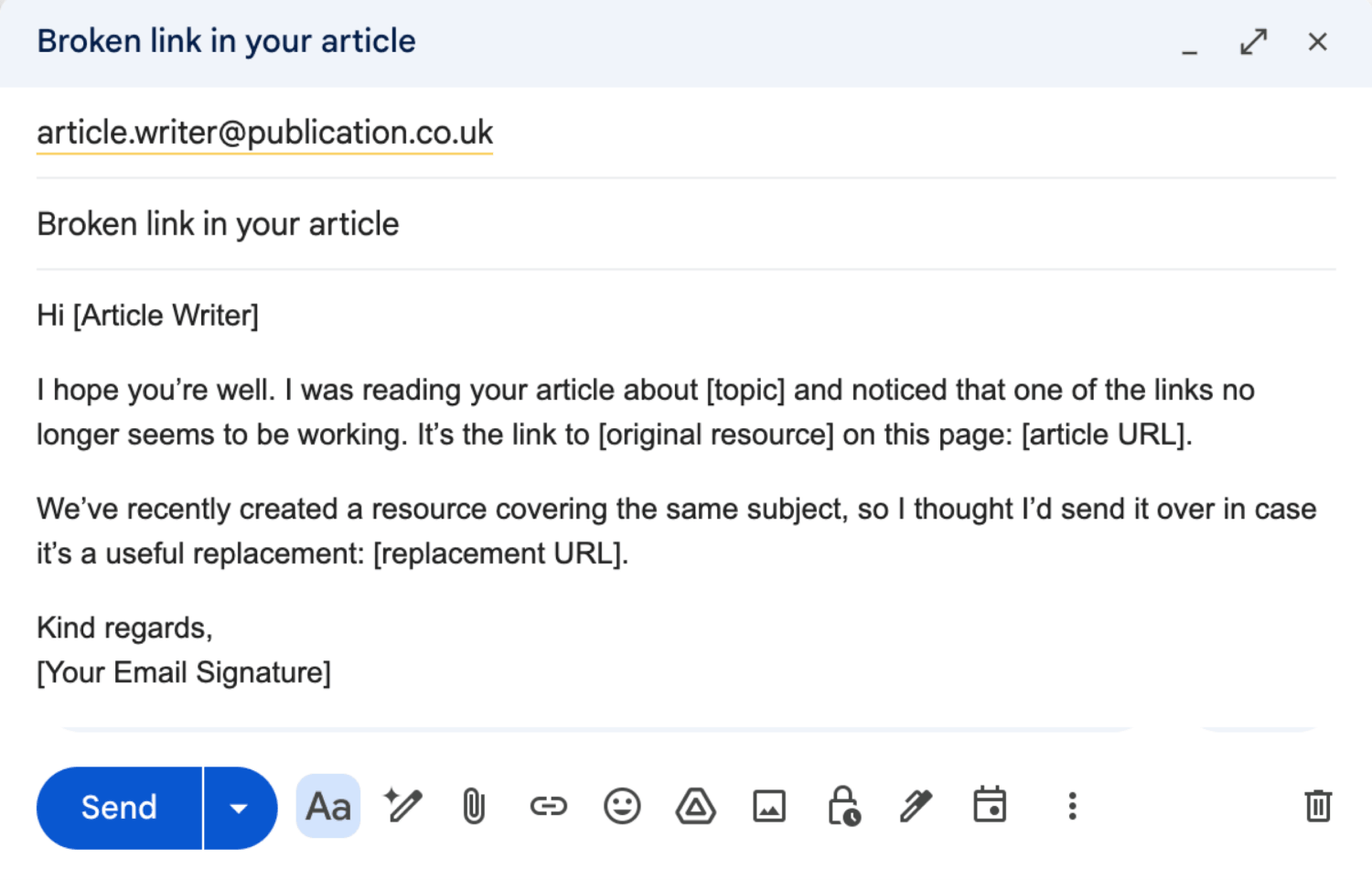
Once it’s published, contact the websites still sending readers to the broken page. Let them know where the broken link appears and show them your replacement.
You’re helping them fix a frustrating reader experience, but they’re under no obligation to choose your page. If your resource isn’t as useful as the original, or isn’t particularly relevant to their article, they have no reason to make the change.
You don’t always need to build an audience from scratch. You can contribute something useful to a publication, podcast, event or community that already reaches the people you want to speak to.
This could involve:
These opportunities often create profile, speaker or episode pages that link to the contributor’s website. But the backlink shouldn’t be the only reason you take part.
The real opportunity is putting your expertise in front of a relevant audience. If the publication’s readers could never become customers, partners or useful industry contacts, an impressive SEO score doesn’t suddenly make it a good opportunity.
Writing one genuinely useful article for a respected publication in your industry is very different from producing 50 generic guest posts for websites nobody reads.
When pitching an idea, begin with the audience. What can you teach them that the publication hasn’t already covered? Why are you the right person to explain it?
Answer those questions well and the backlink becomes a natural part of sharing your expertise.
Competitor backlink research isn’t about finding every website that links to a competitor and asking it to link to you as well.
It’s about understanding what people in your industry consider worth referencing.
Backlink tools can show you which competitor pages have attracted the most links and where those links came from. Look through the results and ask:
You might discover that journalists frequently link to annual statistics, that a competitor earns coverage through expert commentary or that several industry bodies maintain useful member directories.
Those patterns can help shape your own strategy.
If someone promises hundreds of high-authority backlinks for very little money, they haven’t discovered a clever shortcut. They’re probably selling links that are easy to create because nobody genuinely values them.
These tactics are often described as black-hat SEO. They’re designed to manipulate rankings rather than introduce your business to real people, and they can leave you paying for links that Google simply ignores or treats as spam.
Here are some of the main ones to avoid:
These are groups of websites created or controlled primarily to provide backlinks. They may look like real blogs at first glance, but the content is usually thin, covers unrelated subjects and exists for SEO rather than an actual audience.
A listing on a respected trade body or local business directory can be useful. Submitting your website to hundreds of unrelated directories through an automated service is very different. If nobody would genuinely use the directory to find a business like yours, the link probably has little value.
Adding links to blog comments, forums and community posts without contributing anything useful is unlikely to help your SEO. It can also make your business look untrustworthy to anybody who sees it.
Businesses naturally link to suppliers, partners and organisations they work with. The problem begins when links are repeatedly exchanged for no reason other than “you link to us and we’ll link to you”.
Contributing a useful article to a respected industry publication can build your reputation and reach the right audience. Producing near-identical articles for dozens of websites purely to place a backlink is not the same thing.
Trying to make every backlink use the exact keyword you want to rank for can create an unnatural pattern. A publisher should use wording that makes sense within its article, not a phrase chosen solely for SEO.
Google classifies links created primarily to manipulate search rankings as link spam. Its examples include paid links, excessive exchanges, automated link creation and low-quality directory links. You can read the full details in Google’s link-spam policy.
Backlinks aren’t a shortcut into AI Overviews or ChatGPT. Earning one doesn’t guarantee that your website or brand will be included in an AI-generated answer.
However, coverage from trusted websites gives search and AI systems more places to encounter and potentially reference your business. Even an unlinked brand mention can be valuable here.
It isn’t technically a backlink, but your business is still being discussed by an independent source and introduced to its audience.
You can learn more about building this wider authority in our guide to getting cited in AI Overviews and AI Mode.
There isn’t a magic number. The answer depends on how competitive your industry is, which page you want to rank and the quality of the links you already have.
Instead of aiming for an arbitrary total, look at the websites currently ranking for your target searches. This can give you a sense of what you’re competing against, but the focus should still be on earning relevant links from websites with genuine audiences.
Ten valuable backlinks could achieve far more than hundreds of low-quality ones.
Link building is usually a long-term process. You might pick up a quick link by reclaiming an existing brand mention, while a research campaign or piece of digital PR could take several weeks or months to plan, publish and promote.
Even after earning a backlink, you may not see an immediate change in rankings. Give Google time to discover the link and look at its wider value too, including referral traffic, coverage and new relationships.
You can pay for advertising or sponsored coverage, but any paid links should be marked with rel="sponsored" or rel="nofollow".
Buying links that pass ranking value specifically to manipulate Google is against its link spam policies. If somebody is selling hundreds of guaranteed backlinks for very little money, those links are unlikely to come from websites you would genuinely want recommending your business.
Potentially, but you don’t need to panic whenever an unfamiliar or spammy website links to you. Google is often able to recognise and disregard links you had no involvement in creating.
The greater risk comes from backlinks you have deliberately bought, exchanged or manufactured to manipulate rankings. If you receive a manual action or believe a substantial number of artificial links are affecting your website, speak to an SEO specialist before using Google’s disavow tool.
Google describes it as an advanced feature that can harm your performance if used incorrectly.
Yes, they can be.
A nofollow link may not pass link equity in the same way as a standard backlink, but Google doesn’t necessarily ignore it. Google treats nofollow as a hint, which means the link can still help it understand how pages and websites across the web relate to one another.
It can also send relevant visitors to your website, increase brand awareness and introduce your business to a new audience. A nofollow link from a respected national publication could therefore be far more useful than a standard link from a website nobody reads.
Google Search Console’s Links report gives you a free overview of the websites linking to you, your most-linked pages and some of the anchor text being used.
SEO tools such as Ahrefs, Semrush and Moz can provide more detailed backlink data. Bear in mind that no tool will necessarily find every link, so totals may differ between platforms.
A backlink comes from another website and points to yours. An internal link connects one page of your website to another.
Both are useful, but they do different jobs. Backlinks can build visibility and bring new audiences to your website, while internal links help visitors and search engines find their way between your own pages.

