

Phone
01204 89 6440General Enquiries
hello@statuo.co.ukClient Enquiries
accounts@statuo.co.ukHello I’m Adam // General Manager
Drive quality traffic to your site
Talk to me todayHello I’m Faye // Marketing Director
Drive quality traffic to your site
Talk to me todayBrand messaging is the core set of ideas and language a business uses to communicate its purpose, personality and value to its audience.
Katie White
Oct 15, 2026
It shapes what you say about your business and how you say it, from the main message on your homepage to your adverts, social media posts and sales conversations.
A messaging framework identifies the messages that matter most and gives your team a clear, practical way to use them.
Strong brand messaging starts with understanding what customers genuinely care about.
Review customer feedback, testimonials, sales conversations, enquiries, search data, case studies and existing marketing materials. Look at how your competitors describe similar services too.
This can help you find any overused claims and opportunities to say something more meaningful.
Pay particular attention to the words customers use themselves. Their questions, priorities and objections can show you which ideas and language will resonate most.
Ask your customers or sales team:
Clear messaging starts with a clearly defined audience.
Identify who makes the decision, what situation they are in and what they want to achieve. Consider what they already understand, what matters most to them and which concerns could prevent them from taking the next step.
If your business serves several audiences, begin with the primary one. You can adapt the supporting messages for other groups later without changing the central identity of the brand.
Your positioning defines how you want customers to understand your business versus the other options available to them.
Your mission, vision and values can provide useful guardrails here. The position you choose should support what the business stands for, how it operates and where it wants to go.
Consider:
This is primarily an internal statement, so it doesn’t need to appear word for word on your website. Its purpose is to give the rest of your messaging a clear direction.
THINK: Could one of your competitors make exactly the same claim?
If the answer is yes, your positioning may need to become more specific.
Your positioning establishes where the business fits. Your value proposition turns that into a clear reason for the customer to choose you.
It should explain who you help, what you offer, the outcome you provide and what makes your approach worth considering.
Use this template as a starting point, then shape the wording so it sounds natural and reflects what the business can genuinely deliver.
Messaging pillars are the main themes that support your value proposition. They are the ideas you want customers to repeatedly associate with your business.
For most businesses, three or four strong pillars provide enough focus to keep the framework memorable and useful. They might centre on expertise, reliability, convenience, performance, personal service or long-term value.
Each pillar should connect a message to something the customer genuinely values.
Choose pillars that reflect what your business does particularly well and what matters to the audience you are trying to reach.
Proof points give customers a reason to believe your messages.
They could include customer results, case studies, reviews, accreditations, awards, guarantees, delivery times, product specifications or a distinctive process. The strongest proof will depend on the claim you are making.
Claim: We make the process straightforward.
Weak proof: We care about our customers.
Stronger proof: Every customer receives one named contact, fixed project milestones and weekly progress updates.
“We care” is another claim. A specific process shows the customer how that care appears in practice.
If you cannot support a message, either find the evidence or reconsider whether the claim belongs in your framework.
Choose a small number of voice characteristics and define what each one means in practice. This gives everyone writing on behalf of the business clear guidance they can apply consistently.
You can also record preferred terminology, words or clichés to avoid and examples of sentences that do and don’t sound like your brand.
Your central value proposition should remain recognisable, but different audiences may care about different benefits.
For example, a finance director might prioritise cost and risk, while the person using the product every day may be more interested in reliability and ease of use. The offer hasn’t changed, but the message you lead with has.
This helps each audience see the value most relevant to them while keeping the brand’s central identity consistent.
Before sharing the framework with the wider team, check that it is clear, credible and easy to use.
Test it with customers, sales staff and people who are less familiar with the business. If someone outside the project still cannot explain what the business offers after reading the framework, it probably needs simplifying.
Once finalised, keep the framework somewhere your marketing, sales, customer service and leadership teams can easily access. This gives everyone a shared reference when communicating on behalf of the business.
Give your messaging time to become familiar and recognisable. Review the framework when your audience, services, market position or customer priorities change so it continues to reflect the business accurately.
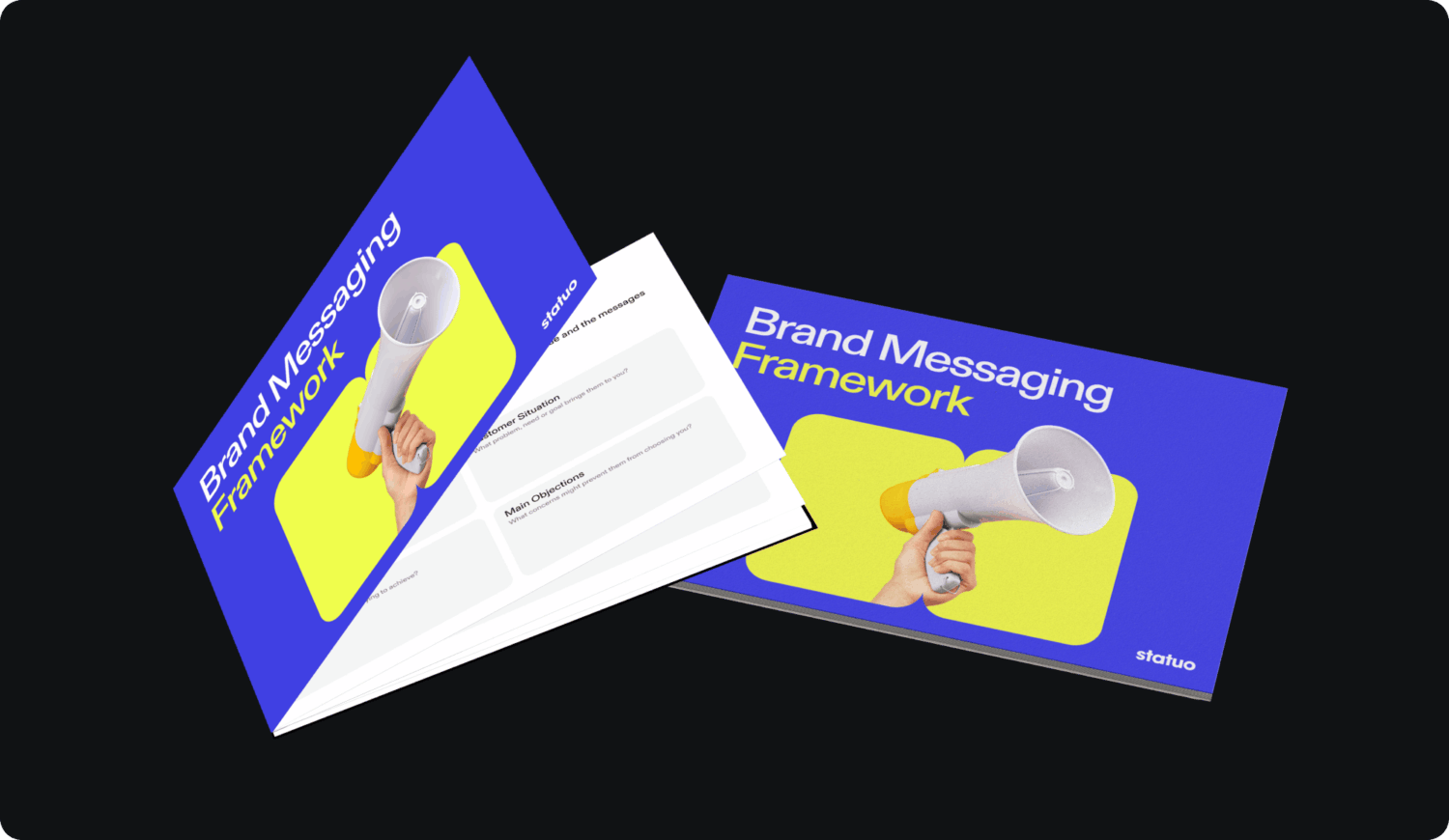
Ready to put it into practice? Download our free Brand Messaging Framework template and use it to define your audience, value proposition, key messages, proof points and brand voice.
Use your framework as the starting point whenever someone creates communication for your brand. It can guide your website copy, sales proposals, advertising, social media, email marketing, PR and customer communications.
The emphasis and wording can change to suit the channel. Your homepage might lead with the value proposition, while a sales proposal focuses on the messaging pillar most relevant to that client and the evidence supporting it. A social post may explore one message at a time.
Each piece should reinforce the same overall position and feel recognisably like your business.
Clear messaging makes it easier for customers to understand what sets your business apart and gives your team a consistent direction to work from.
Through research, workshops and brand strategy, our team of experts at Statuo can help you define your position, develop your messaging and carry it through your website, campaigns and wider brand.
Brand messaging defines what your business wants to communicate, including its value proposition, key messages and proof points. Tone of voice determines how those ideas are expressed through the language, personality and style of the brand.
No. A value proposition explains who you help, the outcome you provide and why someone should choose you. A slogan is a short, memorable phrase that may express part of that idea, but it doesn’t need to explain the full offer.
There is no required number, but three or four focused pillars will be enough for most businesses. Each one should communicate a distinct idea that matters to your audience and can be supported with credible evidence.

